THEVALUETRADER RESEARCH
EARNINGS DASHBOARD: AUG 10, 2026
REF: HIMS-Q2-2026-EARNINGS
Hims & Hers Health: Q2 2026 Earnings
Revenue beat, guidance raised, subscribers up 19%, but gross margin cratered and adjusted EBITDA fell year over year. The market is left deciding whether that's a transition cost or the new normal.
Headline
A clean revenue beat, undercut by margin math getting worse, not better.
Executive Takeaway
Hims & Hers beat on revenue ($753.2M, +38% YoY) and raised full-year guidance to $3.1B–$3.3B, but the quality of the earnings underneath deteriorated. Gross margin fell 12 points to 64% as branded GLP-1 medications displaced lower-cost compounded alternatives, and adjusted EBITDA actually declined year over year to $60.3M from $82.2M, even though it beat Wall Street's estimate. Revenue per subscriber rose to $92 from $76, because branded products carry a higher price tag, but that pricing power didn't cover the higher cost of sourcing them. Management's own updated guidance echoes the same tension: the EBITDA guidance ceiling was trimmed from $350M to $325M even as the revenue guide rose by roughly $300M. The biggest positive is that growth itself isn't the problem: subscribers, international expansion, and full-year revenue guidance are all accelerating. The biggest risk is that this margin compression looks less like a one-quarter blip and more like a structural cost of the strategy shift.
φ 01
Q2 at a Glance
REVENUE$753.2M: +38% YoY
GAAP EPS-$0.37: vs +$0.17 YoY, missed -$0.05 est.
ADJUSTED EBITDA$60.3M: down from $82.2M YoY, still beat est.
GROSS MARGIN64%: down from 76% YoY
SUBSCRIBERS2.891M: +19% YoY
REVENUE PER SUBSCRIBER$92/mo: up from $76 YoY
FY2026 REVENUE GUIDANCE$3.1B–$3.3B, raised
CASH + SHORT-TERM INVESTMENTS~$841M
φ 02
What Drove the Quarter
Four things shaped the print. Three point toward genuine strength; one, the branded GLP-1 mix shift, is the same driver behind both this quarter's biggest positive and its biggest problem.
01. International Expansion via Eucalyptus
What happened: International revenue grew roughly 17-fold YoY to $131.4M after the Eucalyptus acquisition closed in June, adding reach across the UK, Canada, Germany, Ireland, France, and Spain.
Why it matters: This is mostly an acquisition-driven step change, not organic growth. The real test starts now: whether HIMS can grow that acquired base rather than just having added it.
02. Branded GLP-1 Mix Lifted Revenue Per Subscriber
What happened: Monthly revenue per average subscriber rose to $92 from $76 a year ago, as HIMS's strategic shift toward branded GLP-1 medications, with compounded versions offered only "on a limited scale," pushed more subscribers onto higher-priced products.
Why it matters: Higher revenue per subscriber looks like pricing power. It came bundled with a much higher cost of goods, which is exactly why gross margin moved in the opposite direction; see Section 04 below.
03. Domestic Growth Re-Accelerated
What happened: U.S. revenue grew 16% YoY to $621.8M, and management said domestic growth accelerated during the quarter and is expected to keep accelerating through the second half.
Why it matters: After a softer Q1, this is evidence the core U.S. subscriber business isn't stalling, it's simply growing more slowly than the acquisition-boosted international segment.
04. Guidance Raised on the Top Line
What happened: Management raised FY26 revenue guidance to $3.1B–$3.3B from $2.8B–$3.0B, roughly a 10% increase at the midpoint.
Why it matters: A raise this size signals real confidence in the growth trajectory, but the EBITDA side of that same guidance moved in a notably less confident direction (Section 08).
Consensus (Third-Party)
Revenue beat a consensus range of roughly $700M–$730M by 3–8% depending on data provider. GAAP EPS of -$0.37 missed the roughly -$0.05 estimate by about $0.32. Adjusted EBITDA of $60.3M beat the ~$45M–$47M estimate by 27–34%, a beat against Wall Street even as the number itself fell versus a year ago.
φ 03
The Real Story: Margin, Not Growth
HIMS doesn't have a growth problem this quarter. Revenue, subscribers, and guidance are all up. The problem is what's happening beneath the top line: gross margin fell 12 points, and adjusted EBITDA, the metric most closely tied to underlying profitability, actually shrank year over year, despite beating Wall Street's estimate. A number can beat a lowered bar and still be getting worse; that's what happened here.
Gross Margin Q2'25
76%
Gross Margin Q2'26
64%
Adj. EBITDA Q2'25
$82.2M
Adj. EBITDA Q2'26
$60.3M
Company-reported, GAAP gross margin and non-GAAP adjusted EBITDA
Management View
HIMS described "a strategic shift for our United States weight loss offering," transitioning to "providing access to branded GLP-1 medications, and offering access to compounded GLP-1 medications through our platform on a limited scale."
TVT Interpretation
That single sentence explains most of this quarter's tension. Branded GLP-1s cost HIMS meaningfully more to source than the compounded formulations they're replacing, and the company hasn't priced that cost increase through to subscribers dollar-for-dollar. The result: revenue per subscriber goes up, gross margin goes down, and both are the same decision playing out on two different lines of the income statement.
Operating and net results absorbed both the margin compression and one-time items. Operating loss was $(97.2)M versus operating income of $26.7M a year ago; net loss was $(86.3)M versus net income of $42.5M. Six-month restructuring charges tied to the GLP-1 shift totaled $38.1M, and six-month legal contingency charges reached $62.5M (more on both in Section 06).
φ 04
ARPU vs. Margin: The Paradox in the Numbers
It's worth stating plainly, because the two metrics point in opposite directions: revenue per subscriber rose 21% year over year while gross margin fell 12 points over the same period. Both are consequences of the same branded-GLP-1 pivot: the product got more expensive to buy and more expensive to sell.
Revenue / Subscriber, YoY
$76 → $92
Gross Margin, YoY
76% → 64%
For investors, the takeaway isn't that one number is "real" and the other is "fake." Both are accurate. It's that ARPU growth driven by a costlier product mix is a weaker quality of growth than ARPU growth driven by pure pricing power or upsell, because it doesn't automatically convert into more profit per subscriber. Whether HIMS can narrow that gap, through better wholesale terms, scale, or a more favorable branded/compounded mix, is the single most important unit-economics question in this report.
φ 05
International Expansion & the Eucalyptus Deal
International (Rest of World) revenue reached $131.4M, up roughly 17-fold YoY, following the June close of the Eucalyptus acquisition, expanding HIMS's footprint into the UK, Canada, Germany, Ireland, France, and Spain, among other markets.
U.S.: 82.6%
International: 17.4%
$621.8M U.S. revenue$131.4M international revenue
Management has previously pointed to a longer-term ambition of $1 billion-plus in international revenue; this quarter's jump is a real structural step in that direction, but it is overwhelmingly acquisition-driven rather than organic. The purchase price for Eucalyptus was not disclosed in the earnings release. What matters from here is the organic growth rate of the combined international base once the acquisition's one-time step change laps itself.
φ 06
Balance Sheet & Capital Structure
CASH & EQUIVALENTS$609.8M
SHORT-TERM INVESTMENTS$231.2M
CONVERTIBLE SENIOR NOTES OUTSTANDING$1,365.3M
TOTAL STOCKHOLDERS' EQUITY$324.1M
FREE CASH FLOW (Q2)-$68.2M
SHARE BUYBACK AUTHORIZATION$250M, authorized Nov 2025
HIMS holds roughly $841M of cash and short-term investments against $1.37 billion of convertible debt and just $324.1M of total stockholders' equity: convertible notes run more than four times the size of the equity base. That's not an immediate solvency concern given the cash on hand, but it is a capital-structure fact worth tracking: a heavier reliance on convertible debt than the original document suggested, with real dilution risk if the notes convert and refinancing risk whenever they eventually mature.
The $250M buyback program, authorized in November 2025, followed a prior $100M program that was fully utilized. We could not confirm from available disclosures how much of the new authorization has actually been repurchased through Q2. Buying back stock while burning free cash flow and carrying substantial convertible debt is a tension worth watching rather than a settled positive.
φ 07
Legal & Regulatory Overhang
This is more tangled than a single "resolved dispute," and it's worth separating the threads:
FTC lawsuit (active): The FTC, joined by Utah and California, sued HIMS in late July 2026, alleging unlawful sharing of consumer health data with advertising platforms and deceptive billing/cancellation practices. This is the freshest and least resolved of the three items.
Novo Nordisk patent suit (resolved, then superseded): Novo Nordisk sued HIMS on February 9, 2026 over compounded copies of Wegovy; the stock fell sharply on the news. Novo Nordisk dropped the suit in March 2026, and the two companies announced a new collaboration the same month for HIMS to offer branded Wegovy, alongside HIMS's shift to a limited-scale compounded offering.
Securities class action (ongoing): A separate shareholder suit alleges HIMS misrepresented the terms of its original 2025 Novo Nordisk partnership before its termination. The lead-plaintiff deadline passed in August 2025; the litigation itself remains open.
Six-month legal contingency charges reached $62.5M, recognized in G&A, on top of roughly $15M already booked in Q1, implying a meaningfully larger incremental charge in Q2 alone. Combined with the $38.1M of six-month restructuring costs tied to the GLP-1 shift, "one-time" items have now shown up in back-to-back quarters, which raises a fair question about how one-time they really are.
φ 08
Guidance Deep Dive
The revenue raise is straightforward. The EBITDA guidance tells a more cautious story once you look at both ends of the range.
FY26 EBITDA (prior)
$275M–$350M
FY26 EBITDA (new)
$275M–$325M
Ceiling trimmed by $25M; floor unchanged, scaled to the prior guide's $350M ceiling
The floor of the EBITDA range held at $275M, but the ceiling was cut from $350M to $325M, even as the revenue guide rose by roughly $300M at the midpoint. Rough math: the prior guide implied about a 10.8% full-year EBITDA margin at the midpoint; the new guide implies closer to 9.4%. Management is effectively guiding to a lower-margin year than it was three months ago, even while guiding to more revenue.
For Q3 specifically, management guided to revenue of $880M–$900M (about 12% above consensus heading into the print) and adjusted EBITDA of $75M–$95M, implying a 9–11% margin, roughly in line with or slightly above Q2's 8% margin. That's a signal margin isn't guided to collapse further in the near term, but it's not a guided snap-back to last year's levels either.
φ 09
Bull Case vs. Bear Case
Bull Case
Positives
Subscribers, revenue, and full-year guidance are all growing, and domestic growth specifically re-accelerated to 16% after a softer Q1.
Eucalyptus gives HIMS a real, already-executing step toward its international ambitions rather than a purely aspirational target.
Revenue per subscriber rising to $92 shows the branded GLP-1 pivot does carry real pricing power, even if margin hasn't caught up yet.
Roughly $841M of cash and short-term investments provides a real cushion to absorb further one-time legal and restructuring charges.
Q3 guidance implies margin stabilizing near current levels rather than deteriorating further in the immediate term.
Bear Case
Concerns
Adjusted EBITDA fell YoY despite beating estimates: the underlying profitability trend is negative even where headlines read positive.
The FY26 EBITDA guidance ceiling was cut even as revenue guidance rose, meaning management itself is now modeling a lower-margin year.
Convertible debt of $1.37B against just $324.1M of equity is a heavier capital structure than headline cash figures suggest.
The FTC lawsuit is fresh, unresolved, and touches core parts of the business model: data monetization and subscription billing.
"One-time" restructuring and legal charges have now recurred for two straight quarters, weakening the case that they're truly non-recurring.
Repeat One-Time Charges
Q1 2026 carried $33.5M of restructuring charges and roughly $15M of legal costs; Q2 added further restructuring (six-month total $38.1M) and a much larger legal contingency charge (six-month total $62.5M). Two consecutive quarters of "one-time" items in the same two categories is a pattern, not a one-off. Investors should treat near-term GAAP results as understating a run-rate that still includes real, recurring transition costs.
φ 10
What Could Change the Trajectory?
Margin Could Recover If
Branded GLP-1 sourcing costs decline as HIMS gains scale or negotiates better wholesale terms with manufacturers.
The Eucalyptus integration drives operating leverage as shared infrastructure spreads across a larger international base.
Legal and restructuring charges roll off as the FTC matter and remaining litigation are resolved.
Margin Could Stay Pressured, or Worsen, If
The FTC case produces a settlement or consent decree that imposes new compliance costs on data practices and billing.
Further compounding-related disputes resurface as branded and compounded GLP-1s continue to coexist on the platform.
The branded mix keeps growing faster than any offsetting cost efficiencies, pulling gross margin lower before it stabilizes.
φ 11
What to Watch Next Quarter
Gross margin: Does it stabilize near 64% in Q3, or keep sliding as the branded GLP-1 mix keeps growing?
FTC litigation: Any settlement, consent decree, or escalation of the data-sharing and billing-practices case?
EBITDA margin guide: Does management hold the trimmed FY26 range, or narrow it further as the year progresses?
International organic growth: Stripping out Eucalyptus, is the international base actually growing, or was this a one-time step change?
One-time charges: Do restructuring and legal contingency costs shrink in Q3, or recur again for a third straight quarter?
Next scheduled report: Q3 2026, expected November 9, 2026.
φ 12
TVT Verdict
The quarter proved HIMS's growth engine is intact: revenue beat by a wide margin, subscribers grew 19%, international expansion took a real structural step forward, and management raised full-year revenue guidance by roughly 10%.
The key risk is quality of earnings. Gross margin fell 12 points, adjusted EBITDA declined year over year despite beating estimates, and management's own updated guidance quietly lowered its implied full-year margin even as it raised revenue. Layer on a genuinely tangled legal picture: an active FTC lawsuit, ongoing securities litigation, and two straight quarters of "one-time" restructuring and legal charges, and this reads less like a clean beat than the original headline suggested.
From here, the case turns on whether branded GLP-1 economics improve with scale and whether the FTC matter resolves without lasting cost, or whether 64% gross margin and a sub-9%-EBITDA-margin full year are simply the new shape of this business.
The Question Now
Is HIMS trading margin for growth as a temporary cost of going branded and going international, or is this quarter's margin structure closer to the new normal?
Revenue
$753.2M (+38%)
GAAP EPS
-$0.37 (miss)
Adj. EBITDA
$60.3M (-27% YoY)
Gross Margin
64% (-12pts)
FY Revenue Guide
$3.2B (raised)
Next Report
Nov 9, 2026
Ï 13
Trade Idea
HIMS heads into the next print with a genuinely split picture: durable top-line growth on one side, a real deterioration in earnings quality on the other. Rather than calling a winner off the headline beat or miss, the framework below lays out what each side of that split would look like in practice, and what to watch for as it resolves.
If Margin Stabilizes
Growth Case Re-Asserts
Q3 gross margin holds near 64% rather than sliding further, matching management's own signal that the ratio isn't guided to collapse.
International organic growth (ex-Eucalyptus) shows through in reporting, evidence the acquisition wasn't a one-time sugar high.
The FTC matter moves toward resolution without a costly consent decree attached.
In that scenario, the market has room to re-rate the stock back toward the growth story rather than the margin story.
If Margin Deteriorates Further
Quality-of-Earnings Case Dominates
Gross margin slips below the 64% printed this quarter, or the EBITDA guidance range gets trimmed again next print.
A third consecutive quarter of "one-time" restructuring or legal charges, undermining the one-time framing entirely.
FTC litigation escalates into a settlement that imposes recurring compliance costs on the core data/billing model.
In that scenario, revenue beats stop mattering to the tape the way they did this quarter, because the market starts pricing the business on EBITDA quality instead of top-line growth.
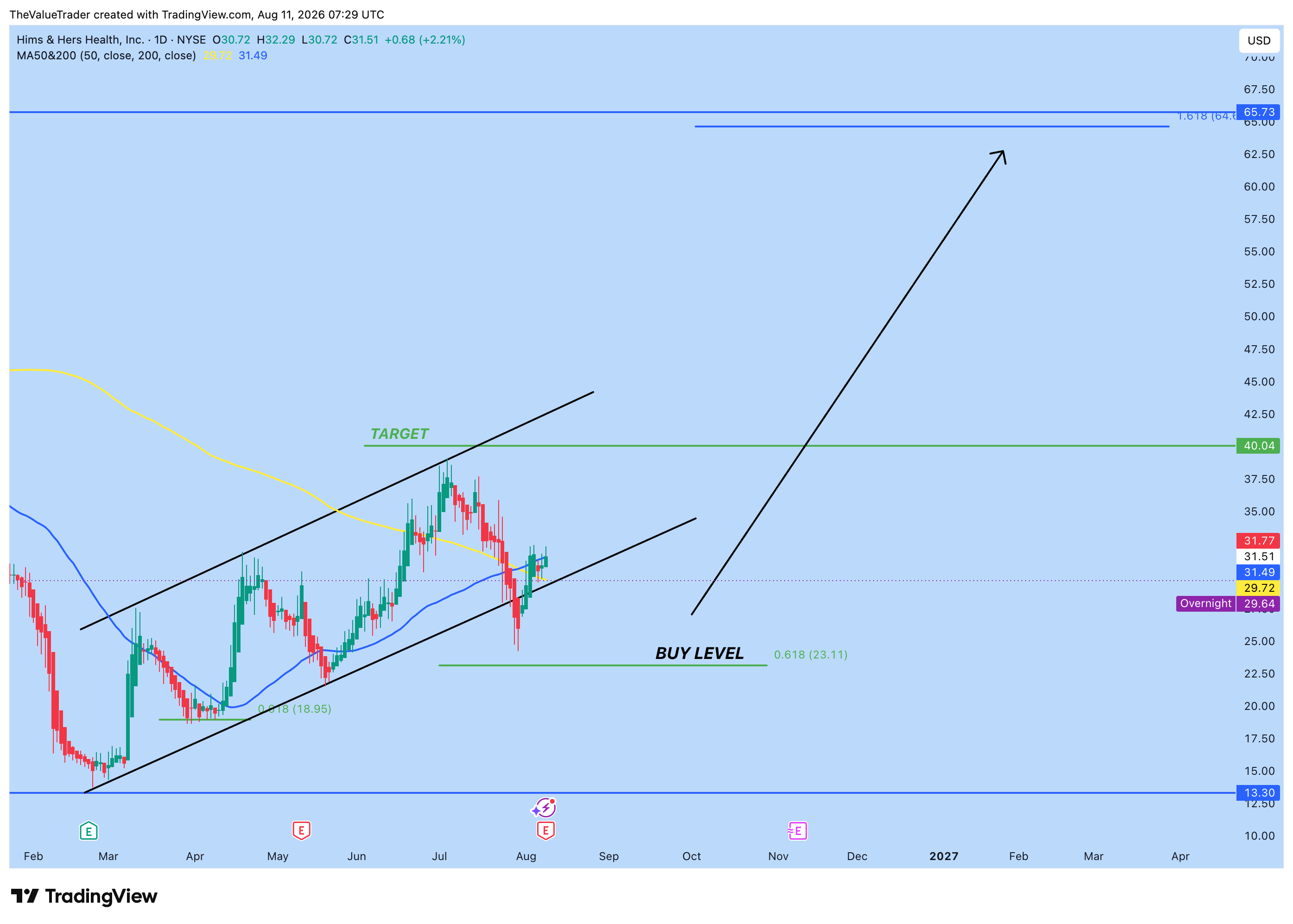
In practice, the read is structural rather than fundamental. Watch how price reacts to this print and the next one: if pullbacks keep holding above the post-earnings low, that higher-low pattern lines up with the growth case reasserting itself, but if the stock keeps carving out lower lows into results, that's the market voting for the margin story instead. Either way, it's that price structure, not the next headline number on its own, that will actually confirm which case is playing out.
Click to enlarge
HIMS — Daily. Rising channel off the early-2026 low, with a buy-level reference near the 0.618 retracement, a target reference near $40, and the 1.618 extension near $65.73 marked for structural context. Illustrative only — not a specific entry, exit, or price target. Click the chart to enlarge.
Not a Recommendation
This section describes a way of thinking about the setup, not a specific entry, exit, or price target, and it is not a recommendation to buy, sell, or hold HIMS. Position sizing, risk management, and the decision to act at all are entirely your own responsibility. See the Elliott Wave and Support & Resistance guides on the TVT homepage for the structural framework referenced above.
Data Sources
Hims & Hers Health Q2 2026 Earnings Release (Investor Relations / SEC Form 8-K, Aug 10, 2026)
Hims & Hers Health Q1 2026 Earnings Release (for YoY and sequential context)
Public reporting on FTC and Novo Nordisk-related litigation, as covered by multiple financial news outlets
Consensus estimates: aggregated third-party analyst data as reported by financial data providers, not company-reported figures
This content is for educational and informational purposes only and reflects TheValueTrader's independent analysis of publicly reported earnings data. It is not financial advice, investment advice, or a recommendation to buy or sell any security. All investing involves risk, and you are responsible for your own decisions. Always do your own research.